Let’s be honest. Most of us just want to do big, epic projects.
I get it because I'm exactly the same way. When I look back at some of the projects I tried to take on in college, they were crazy ambitious. Way too big for where I was at the time. But those big dreams comes from being passionate, and that is a good thing. you gotta channel that.
If you are a 3D character artist like me, or are working on large creative projects then you:
Want to get really good.
Want to make great work.
And get there as fast as possible.
But here is the reality check: Doing only big projects has big downsides.
Big projects are the easiest projects to abandon. Life happens. Motivation drops. The scope becomes overwhelming. Most people don't finish.
Finishing is a skill. And it is one of the most important ones.
They slow down your growth. You grow the most when you finish projects. If a project takes six months or a year, that means you've only practiced modeling, texturing, lighting, rendering, and finishing once in that entire time.
So If your goal is to improve faster and build a strong body of work, doing only massive projects actually works against you.
The Method
The Bricks and Pillars Method is how I personally structure my projects, and it is what I teach to artists who want to improve faster, finish more work, and build a stronger portfolio over time.
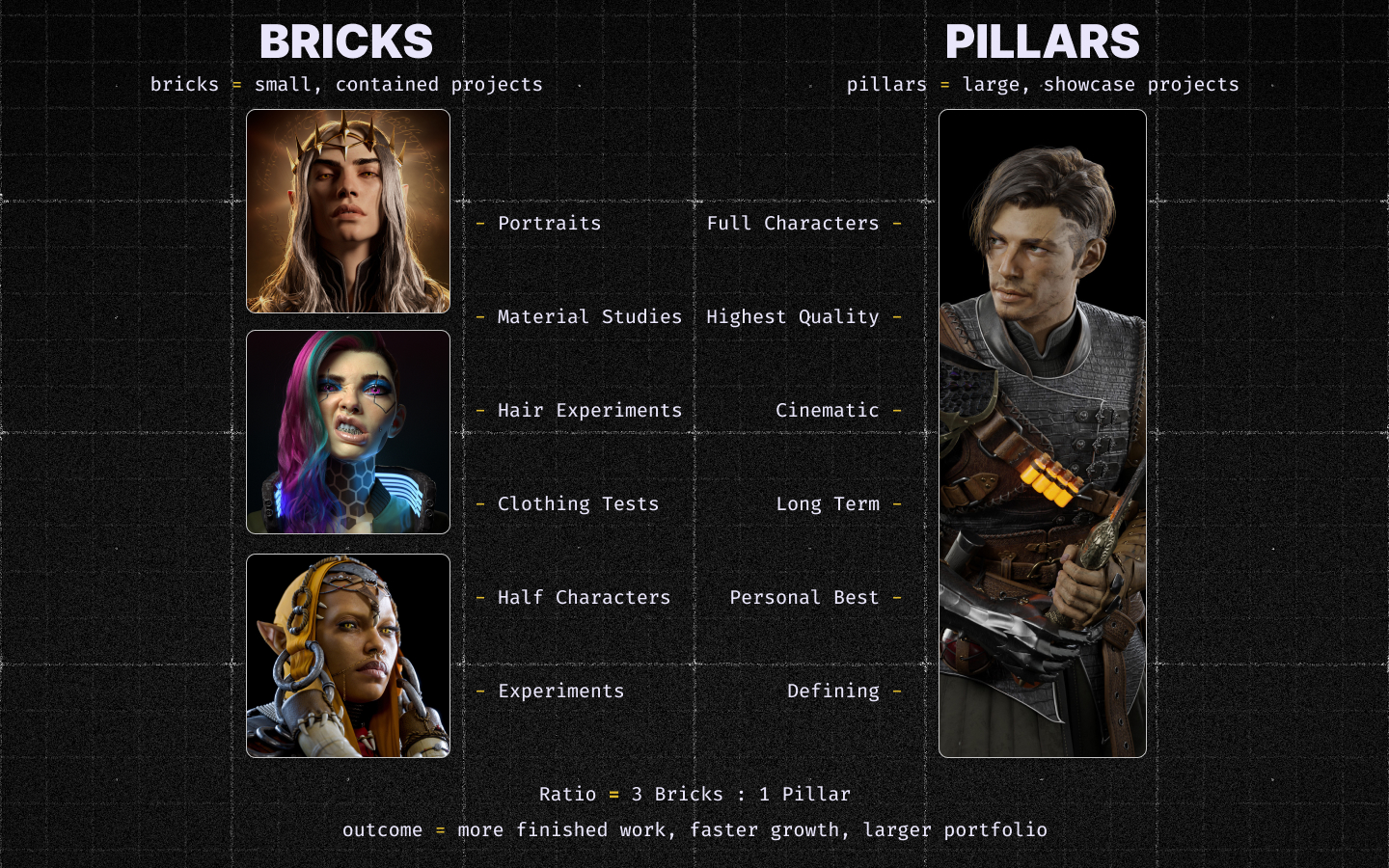
Here's the method: Instead of treating every project like the biggest thing you have ever made, start thinking about your projects as falling into one of two categories: Bricks or Pillars.
Bricks
Bricks are smaller projects with intentionally limited scope. Theses are your skill-building projects. They are where most of your learning happens.
Bricks are not throwaway sketches. They are still finished and presentable. The difference is that they focus on one or two specific goals instead of everything at once.
This is where you
• Try a new workflow
• Learn a new tool or software
• Practice a specific technique
• Do a focused study
• Experiment without pressure
• Improve speed and confidence
Brick Examples
• Character bust portrait
• Half-body character
• Hair study
• Clothing study
• Material study
• Lighting & rendering test
Each brick has a clear goal and a clear end point. You start it, you finish it, and you move on.
Most Bricks should take less than a week, sometimes more but try and limit them to less than a month. You want to practice discipline with scope and finishing these.
The priority is finishing, not perfection.
Pillars
Pillars are your big projects. Your showcase projects.
These are your
• Hero pieces
• projects that represent your highest level
• works that hold up your portfolio
Pillars are where you apply what you already know. You can still push yourself a bit, but this is not the place for heavy experimentation. This is where you want to execute well and polish the result.
These projects take more time, more planning, and more energy. If Bricks are sprints, these are marathons. They are meant to be fewer in number and higher in impact.
Pillar Examples
• Full-body character with complete outfit and props
• Fully realized game-ready character in Unreal
• Cinematic-quality presentation piece
• Portfolio anchor project
How it works
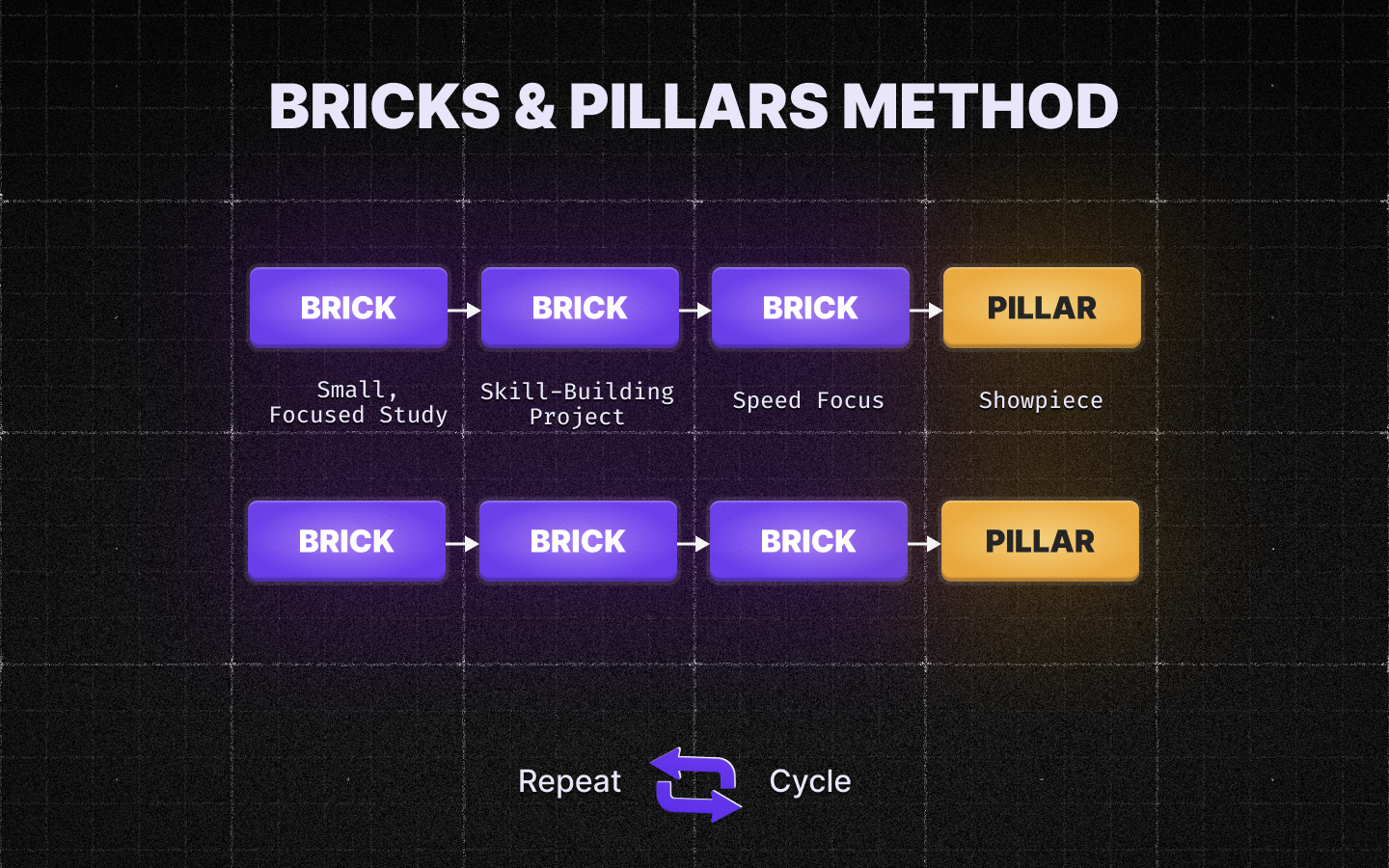
Instead of doing pillar after pillar, stack bricks first. Then do a pillar. Then go back to bricks.
As a rule of thumb, I recommend a 3:1 ratio. Three bricks for every pillar.
Every brick gives you more reps. More practice starting, solving problems, finishing, and presenting work. So when you start your next pillar, you are better at everything. Modeling, texturing, lighting, organization, and time management. This is how you're complete more projects and stronger work at the same time. Load your energy bar up on smaller projects so you can Super your big project. Hadoken!
That big project you have been dreaming about will be better if you earn it.
This approach helps you
• Get more finished projects done
• Improve faster without burning out
• Plan big projects without getting stuck
• Build a portfolio that actually represents your growth
If you care about doing big, epic character art projects and you want them to be great, this method will help you get there. And it's simple.
Scope & Size
Projects can come in all kinds of scopes and sizes. To keep things simple, think of projects in 3 sizes: Big, Medium, and Small.
Not every project needs to be big and some things you want to do aren't exactly small, that's why it helps to have 3 sizes.
A small project might be a bust.
A medium project might be a half character.
A large project is the full character pillar.
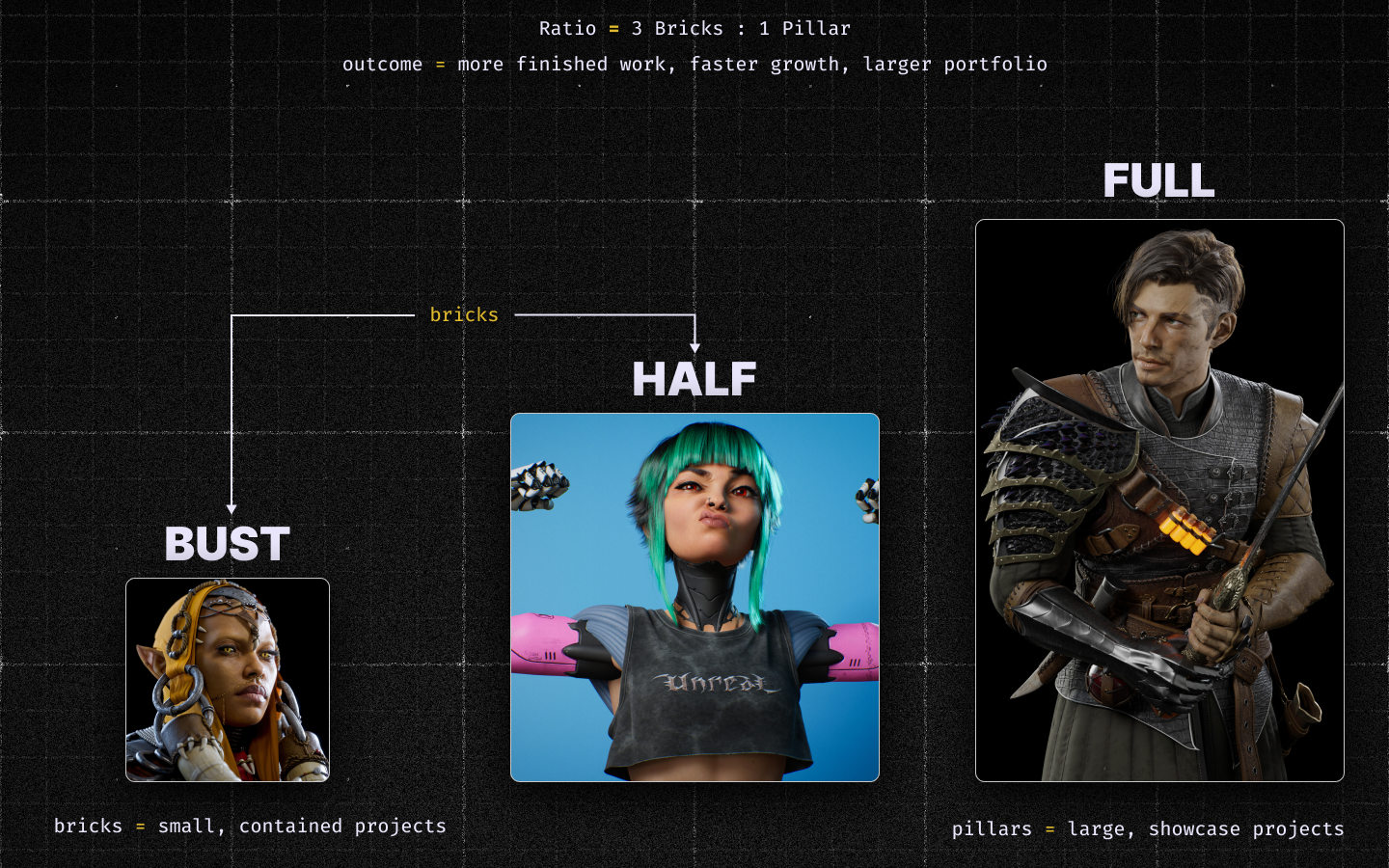
Half Character models are Bricks. Big ones but still Bricks.
You can make the upper half of a character and avoid doing the back in less than a month and achieve almost as much as a full character.
All three are valuable. They just serve different purposes. Before you commit to the largest version of a project, think could this be medium? Could I achieve everything I want by making half a character?
Why This is Powerful
Compounding interest! If you only do big projects, you might finish one or two a year. But If you mix in bricks, you could finish six or seven projects in the same amount of time.
This means
• More experience
• More finished work
• More improvement
• A stronger portfolio
By completeing some small projects before every big one:
Your second pillar will be better than your first. Your third will be better than your second.
This compounds year after year. Warren Buffet would be proud.
How to Use
The next time you plan a project, ask yourself one question: Is this a brick or a pillar? Then treat it as such.
If it is a pillar, make sure you've stacked some bricks recently.
If it is a brick, use it to learn something specific and finish it. fast.
When you finish a big project, do not immediately jump into another one. Do a few bricks. Experiment. Build skills. Then come back stronger.
That is the Bricks and Pillars Method.
Simple, practical, and effective.